Affiliate disclosure: Some links in this article may be Amazon affiliate links, which means I may earn a small commission if you purchase through them, at no additional cost to you.
Skip to PDRN picks: Here
Here is a particular kind of skincare frustration that almost everyone recognizes.
Your skin isn’t necessarily breaking out. It isn’t dramatically irritated. But somehow, it looks tired.
Your complexion seems less plump than it used to. Fine lines appear more noticeable. Makeup doesn’t sit quite as smoothly. Your skin can feel dry even when you’ve been moisturizing, and that healthy-looking glow seems harder to achieve.
This is where the current fascination with PDRN skincare begins.
PDRN has moved from regenerative medicine and wound-healing research into the world of Korean skincare and cosmetic formulations, where it is now appearing in serums, masks, creams and other products.
But behind the trend is a much more interesting question:
What exactly is PDRN, and what can it realistically do for your skin?
Let’s look at the science, the potential benefits, and how you can incorporate PDRN into a skincare routine without treating it like a miracle ingredient.
What Is PDRN?
PDRN stands for polydeoxyribonucleotide.
In simple terms, it is made up of DNA-derived fragments. PDRN has been studied for its role in tissue repair and regeneration, particularly because of its interaction with the adenosine A2A receptor and its involvement in the body’s nucleotide salvage pathway.
That sounds very technical, so here’s the simpler version:
PDRN is being studied because it may help create biological conditions that support tissue repair and regeneration.
Research has investigated PDRN in wound healing, inflammation and tissue regeneration, with proposed mechanisms involving A2A receptor activation, cellular activity and the provision of building blocks through nucleotide salvage pathways.
And this is important: PDRN didn’t start as a beauty trend.
Its scientific story comes largely from research into tissue repair.
That history is one reason the ingredient has become so interesting in regenerative and aesthetic dermatology.
How Does PDRN Work?
One of the most discussed mechanisms is activation of the adenosine A2A receptor.
Research suggests these mechanisms may contribute to tissue repair, cell proliferation, angiogenesis and modulation of inflammation.
Think of it less as:
“PDRN tells your skin to become younger.”
And more as:
PDRN may help support biological processes involved in tissue repair.
That distinction matters.
A skincare serum containing PDRN is not automatically equivalent to a medical PDRN treatment used in clinical research. Formulation, concentration, molecular characteristics, delivery and route of administration can all influence what actually reaches the skin and what effect it can have.
PDRN vs Polynucleotides: Are They the Same?
You’ll often see PDRN and PN (polynucleotides) mentioned together online.
They’re related, but they aren’t identical.
Both are DNA-derived materials, but they differ in molecular characteristics such as polymer length and molecular weight. A recent review describes PDRN as relatively shorter DNA fragments, while longer polynucleotides have been investigated for effects involving extracellular-matrix remodeling and tissue support. (PubMed)
This is why you shouldn’t automatically assume:
PDRN = PN = exactly the same skincare ingredient.
They overlap in the broader regenerative-skincare conversation, but the scientific literature should be interpreted according to the specific material and treatment being studied.
What Can PDRN Do for Skin?
This is where things get interesting—but also where skincare marketing can get ahead of the evidence.
A 2026 systematic review of randomized clinical trials looked at PN and PDRN for skin rejuvenation, scar prevention and wound healing. It identified seven randomized trials involving 183 participants.
The results were encouraging across several outcomes, including wrinkle-related measures, scar quality and wound healing. However, the authors emphasized important limitations: small sample sizes, different treatment protocols and different outcome measures. (PubMed)
So instead of asking:
“Does PDRN fix everything?”
A better question is:
“Which skin goals might make PDRN an interesting ingredient to explore?”
1. Dull, Dehydrated-Looking Skin
The skin goal: More hydrated, plump-looking skin
Sometimes “dull skin” isn’t really about pigmentation.
It can be a combination of dehydration, uneven texture and a loss of that smooth, light-reflective surface that makes skin look fresh.
PDRN has attracted attention in regenerative skincare partly because of its potential effects on tissue repair and skin quality. Clinical aesthetic literature has reported improvements in outcomes such as hydration, elasticity and texture with polynucleotide treatments, although the evidence remains variable.
How to use PDRN
If your main concern is dehydrated-looking skin, look for a PDRN serum combined with established hydrating ingredients such as:
- Hyaluronic acid
- Glycerin
- Panthenol
- Beta-glucan
- Ceramides
The PDRN doesn’t have to do all the work.
In fact, a well-formulated product combining PDRN with familiar humectants and barrier-supporting ingredients may make more sense for a hydration-focused routine.
Check out PDRN hydrating serums → Arencia PDRN Hyaluronic Acid Serum Moisturizer
2. Dry or Stressed Skin
The skin goal: Support a healthier-looking skin barrier
When your skin barrier is struggling, adding more and more active ingredients isn’t necessarily the answer.
Skin can feel tight, rough or uncomfortable, and products that normally feel fine may suddenly sting.
This is where a barrier-first approach makes sense.
Emerging research on polynucleotides has explored their potential use in skin rejuvenation and barrier-related conditions, but this should not be interpreted as proof that every over-the-counter PDRN product can repair a damaged skin barrier.
How to use PDRN
If dryness is your primary concern, pair a PDRN product with ingredients that have a much longer history in barrier-focused skincare:
PDRN serum → ceramide moisturizer → sunscreen in the morning
Look for combinations such as:
- PDRN + ceramides
- PDRN + panthenol
- PDRN + hyaluronic acid
- PDRN + glycerin
The idea is simple:
Use PDRN as one part of a supportive routine, rather than expecting it to replace your moisturizer.
Explore PDRN + barrier-supporting formulas → COSRX 5 PDRN Collagen Vitalizing Serum
3. Fine Lines & Loss of Plumpness
The skin goal: Smoother, firmer, more youthful-looking skin
Fine lines are one of the reasons PDRN has become particularly popular in aesthetic skincare.
The biological rationale is intriguing because tissue regeneration, extracellular-matrix remodeling and skin structure are all relevant to the appearance of aging skin.
Clinical studies of polynucleotide-based treatments have reported improvements in wrinkles, skin texture and elasticity in some participants. However, systematic reviews have also emphasized that the current evidence base is relatively small and that treatment protocols vary considerably. (PubMed)
So PDRN is best thought of as an emerging skin-rejuvenation ingredient, not a replacement for established anti-aging ingredients.
How to use PDRN
A simple routine could look like:
Morning
Cleanser
→ PDRN serum
→ Moisturizer
→ SPF 30–50
Evening
Cleanser
→ PDRN serum
→ Moisturizer
If you already use a retinoid or another strong active, you don’t necessarily need to replace it with PDRN.
Instead, think of PDRN as potentially complementing a routine focused on hydration and skin quality.
Explore PDRN + peptide formulas → TOSOWOONG Pink Peptide 12 PDRN Serum for Firming & Glass Skin, Skin Glow
Can PDRN Help With Acne?
This is an area where I’d be cautious.
PDRN’s regenerative and anti-inflammatory properties have made it interesting in tissue-repair research, but that does not mean PDRN is an acne treatment.
If acne is your primary concern, ingredients with stronger evidence for acne management—such as salicylic acid, benzoyl peroxide or retinoids, depending on the individual—have a more established role.
PDRN may be interesting as a supportive skincare ingredient, particularly when your focus is on skin comfort or post-treatment recovery, but it shouldn’t be marketed as an acne cure.
What About Dark Spots and Hyperpigmentation?
This is another area where PDRN marketing deserves a reality check.
Some research in aesthetic and post-procedural settings has examined pigmentation-related outcomes, including melanogenesis, but the evidence is not strong enough to position PDRN as a primary pigmentation treatment. (PubMed)
If pigmentation is your main concern, ingredients with more established evidence and widespread use include:
- Vitamin C
- Azelaic acid
- Retinoids
- Niacinamide
- Alpha-arbutin
- Kojic acid
PDRN can be an interesting addition to a broader skincare routine, but don’t buy a PDRN product expecting it to erase dark spots on its own.
PDRN for Post-Procedure Skin: Why Is It Getting So Much Attention?
This is actually where the scientific story becomes particularly interesting.
PDRN has been studied extensively in the context of tissue repair and wound healing.
A recent 2026 review of PDRN in aesthetic post-procedure recovery discussed evidence involving procedures such as laser resurfacing, chemical peels, microneedling and radiofrequency. The authors noted promising findings around re-epithelialization, erythema and scarring, while also highlighting the limitations of the current evidence.
Earlier clinical research has also investigated PDRN in wound healing, including a randomized controlled trial involving diabetic foot ulcers. (PubMed)
But there’s an important distinction:
Medical PDRN treatment ≠ applying a cosmetic PDRN serum to freshly injured skin.
If you’ve had a laser treatment, peel, microneedling or another procedure, follow the aftercare instructions given by your dermatologist or practitioner rather than experimenting with cosmetic products on compromised skin.
How to Add PDRN to Your Skincare Routine
You don’t need a complicated routine.
For most people interested in trying a PDRN cosmetic product, the easiest starting point is a serum.
Simple PDRN routine
1. Cleanse
Use a gentle cleanser appropriate for your skin type.
2. PDRN serum
Apply according to the product’s instructions.
3. Moisturizer
Use a moisturizer suited to your skin’s needs.
4. Sunscreen — morning
SPF is essential if you’re trying to maintain healthy-looking skin and prevent photoaging.
Want a little more?
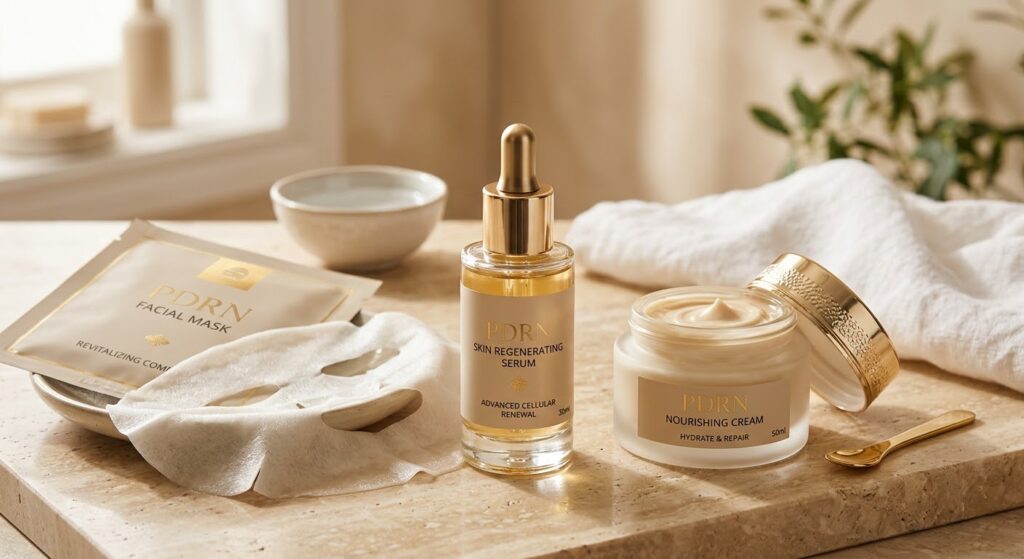
You could also add a PDRN mask occasionally if you enjoy sheet masks or intensive hydration.
PDRN mask → PDRN serum → moisturizer
Think of this as a hydration-focused routine, not a requirement for PDRN to work.
PDRN Isn’t a Miracle Ingredient
This may be the most important part of the entire article.
PDRN is exciting because there is a genuine scientific story behind it.
Research supports biological mechanisms related to tissue repair, and clinical studies have produced promising results in wound healing and some aesthetic applications. But the evidence for cosmetic skincare is still developing. Recent systematic reviews specifically point to small study populations, heterogeneous formulations and treatment protocols, and a need for larger, better-designed trials.
That means you should be skeptical of claims such as:
- “PDRN rebuilds your skin”
- “PDRN replaces retinol”
- “PDRN erases wrinkles”
- “PDRN permanently repairs your skin barrier”
- “PDRN removes pigmentation”
Those statements go further than the evidence allows.
A better way to describe PDRN is:
An emerging regenerative skincare ingredient with promising research around tissue repair and skin rejuvenation, but with important limitations in the current clinical evidence.
And honestly, that’s already interesting enough.
So, Is PDRN Worth Trying?
If your skincare goals are hydration, plump-looking skin, smoother texture and overall skin quality, PDRN is an ingredient worth exploring—especially if you enjoy Korean skincare and newer regenerative-skincare formulations.
But don’t look for PDRN in isolation.
A good skincare product is still about the whole formula.
For example:
PDRN + hyaluronic acid → hydration-focused routine
PDRN + panthenol + ceramides → barrier-supportive routine
PDRN + peptides → plumping/skin-quality-focused routine
PDRN + antioxidants → broader daily skincare routine
And regardless of how interesting the newest ingredient is, the fundamentals still matter:
gentle cleansing + moisturization + sunscreen + consistency.
The Bottom Line
PDRN is more than a social-media skincare trend—but it isn’t a miracle ingredient either.
Its scientific history comes from research into tissue repair and regeneration, and studies have explored mechanisms involving A2A receptor activation and nucleotide salvage. Clinical evidence is particularly interesting in wound healing, while research into aesthetic skin rejuvenation is growing but remains limited. (PubMed)
For cosmetic skincare, the most sensible way to approach PDRN is as a supportive ingredient within a well-formulated routine.
If your goal is hydrated, plump, smoother-looking skin, a PDRN serum may be an interesting addition.
Just remember:
The goal isn’t to find one ingredient that does everything. It’s to build a routine where each ingredient has a useful role.